Pokémon cards are so back, and figuring out what yours are worth is part of the fun, whether you collect physical cards or their digital equivalents. But how can you work out how much your cards would actually fetch in the market?
This guide walks you through how to check your Pokémon card value online using simple steps and reliable tools.
Before you can check a Pokémon card’s price, you’ll need to understand why one card is worth $0.10 and another can reach a mind-boggling $10,000.
The value of your card can be determined by the combination of the following, so keep them in mind as you evaluate your stash:
If you’re ready to get hands-on and figure out what your cards are worth, here are four steps that will make the whole process easy, even if you’re new to collecting.
You can’t look up a price until you know exactly what card you have. The first thing you should check is the Pokémon’s name at the top (like Pikachu).
Then, you’ll need to check for the small set symbol, typically in the bottom-left or bottom-right corner, which will tell you which set the card is from. For instance, the Sword & Shield base set symbol is a silver sword crossed diagonally behind a silver shield.
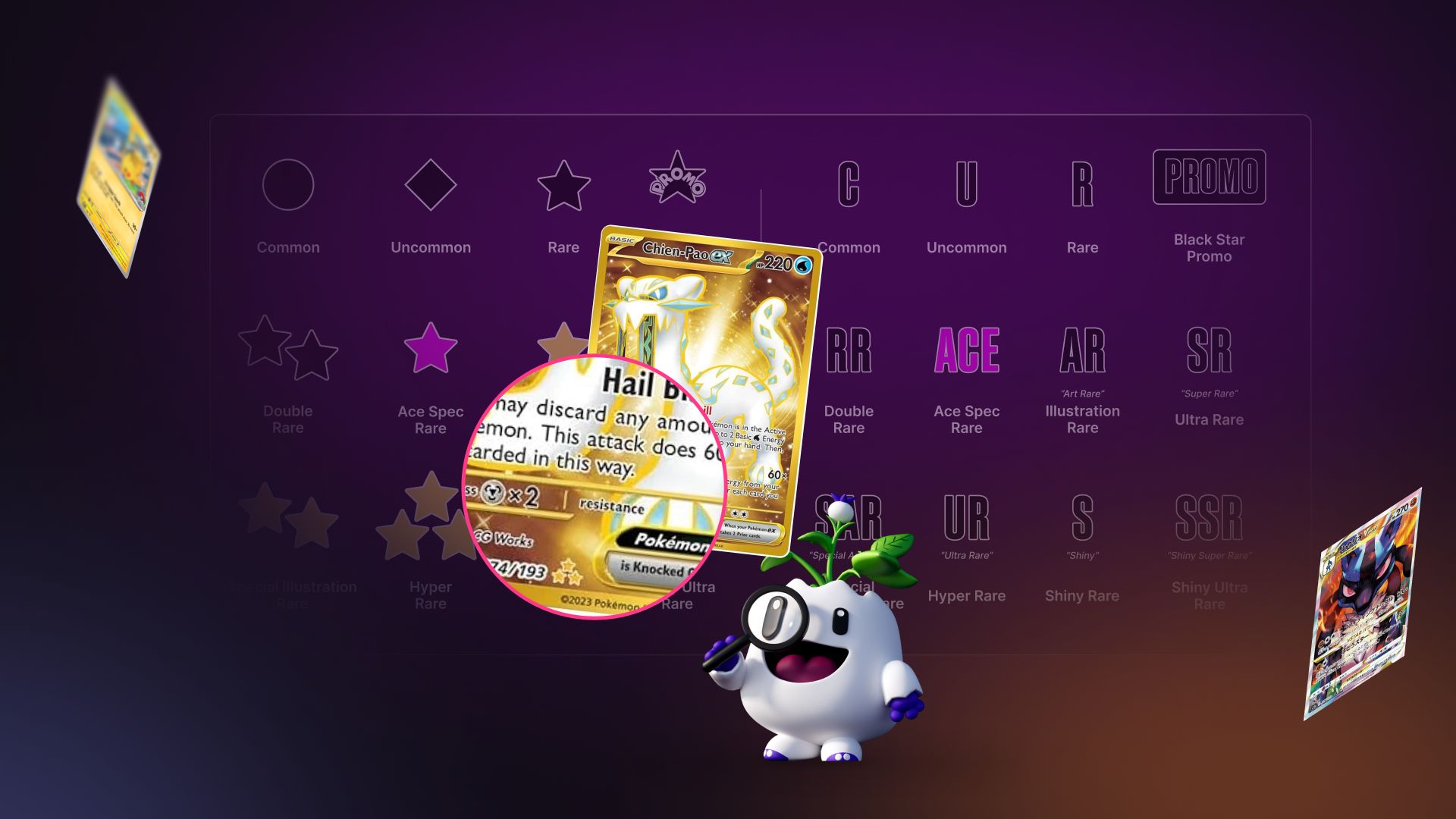
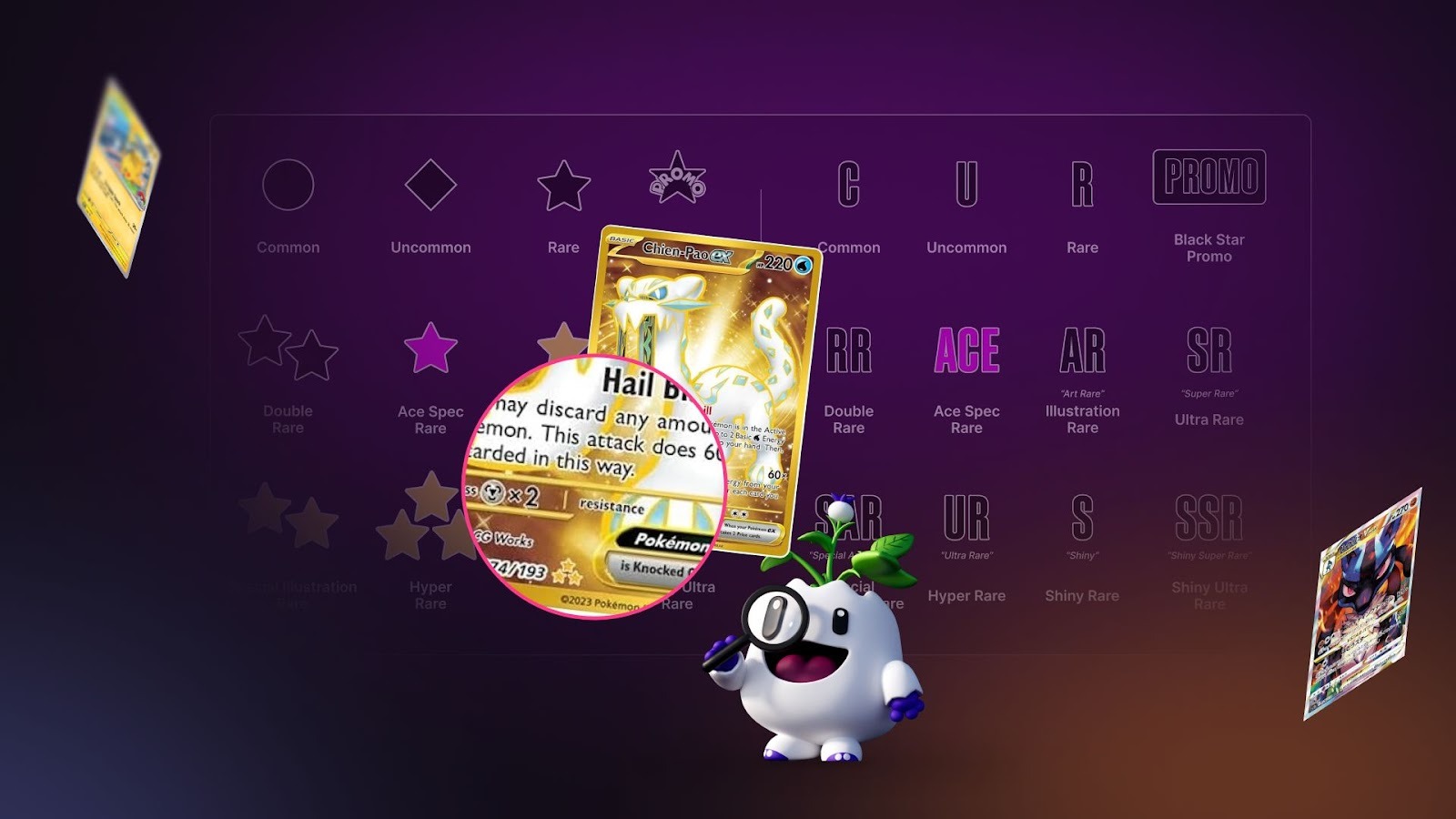
Note the rarity symbol (usually at the bottom-center) and any edition markers like 1st Edition and promo stamps.
Next is the card number (e.g., 58/202 or 203/202), which refers to the card’s position in the set. If the first number is higher than the second (say, 203/202), this means it’s a Secret Rare and therefore can be potentially very valuable.
The last critical detail is the card’s variant (such as holographic, reverse-holo, etc.).
Now comes the hardest part for new collectors. You’ll need to be brutally honest and look at your card under a bright light to evaluate your card’s state.
For example, if it’s in mint (M) or near mint (NM) condition, it can have one or two really tiny imperfections but otherwise look perfect, with no scratches, scuffs or bends.
If there’s minor wear, visible in the form of slight whitening along the edges, maybe a teeny scuff on the holo or minor corner wear, then it’s Lightly Played (LP).
Moderately Played (MP) cards show more obvious wear, with whitening on multiple edges, light scratches or scuffs on the cards’ faces.
Finally, a Heavily Played (HP) or Damaged (DMG) card has seen better days and likely has major whitening, deep scratches, stains, creases, bends or tears.
All of these may reduce the card’s worth, in some cases by as much as 90% compared to the default value of an NM card or a 20-40% decrease for an LP one, though this varies.
Once you’ve established which card you have (for example, Charizard Evolutions set 11/108 Rare Holo) and what condition it's in (maybe LP), it’s time to check its exact value.
This can be done through popular marketplaces like TCGplayer, Rare Candy, eBay and price charting websites in the case of a physical card. If you want to check the price of a Pokémon trading card NFT, you can head over to a reputable online trading platform like Magic Eden.
On eBay, make sure to ignore active listings, as they may have exorbitant prices attached to them, like someone valuing their damaged Charizard at an absurd $50,000. Instead, search for your card and filter the results by sold items. That way, you’ll see what people have actually paid recently.
If your collection is large enough to send you into a tailspin, technology is your best friend.
You can use apps with scanner features like the one offered by the TCGplayer app, where you can point your phone’s camera at the card and the app lists its current market price.
Another useful price-checking option comes in the form of digital binders like the ones offered by the Rare Candy marketplace app. Just scan your collection and the app will add the cards to your binder, showing you the total value of your entire collection at the same time. Plus, you’ll get that feeling of great satisfaction as you watch those numbers grow.
Checking values is one thing, but collecting, trading and experiencing the joys of the hobby is another. At Magic Eden, we’ve embraced a new way to do just that in the form of Pokémon NFT packs. If you love the idea of virtually ripping packs and redeeming your pulls for the physical cards (although you don’t have to), then this one’s for you.
Head over to Magic Eden Packs and start ripping today!
To find out how much your Pokémon cards are worth, you must first identify the card’s name, set, number and rarity. Then, you assess its condition (Mint, Near Mint, Lightly Played, Moderately Played, Heavily Played or Damaged). Finally, you can look up its price on sites like TCGplayer or Rare Candy, or check sold listings on eBay to see how much recent buyers paid for it.
Yes, absolutely. This is one of the easiest ways to check your Pokémon card value if you hold a lot of cards. Many popular TCG apps have a built-in scanner feature. You can use your phone’s camera to scan the card, and the app will identify it and show you its current market value instantly. This saves you from having to manually look up every single card’s name and number.
To check the rarity of your Pokémon card, look at the symbol at the bottom. A circle means it’s Common, a Diamond denotes an Uncommon card, whereas a Star identifies a Rare item. That said, there are even rarer cards, called Secret Rares, which have a card number higher than the set number (such as 101/100).
To check for Pokémon card prices, you should use the most trusted websites like TCGplayer.com, which offers an average price of recent sales for each card, or eBay.com, where you can filter cards by sold items to see what buyers actually paid.
If you want to check the value of your entire collection of Pokémon cards, the best way is to deploy a scanner app or digital binder. Scanning each card individually into an app (like TCGplayer’s or others) will allow the app to catalog your collection and show you its total value that updates with current market prices.
The information provided on this website is provided for general educational purposes only and is in no way financial or investment advice. Certain information may have also been provided to us or prepared by third parties; these materials are provided for convenience and are not an endorsement by Magic Eden. Magic Eden is not liable for any errors, changes or amendments to such information, including any actions taken in reliance on such information.